Marvel Splendor Organizer / Case study
I reorganized a whole board game around setup and play.
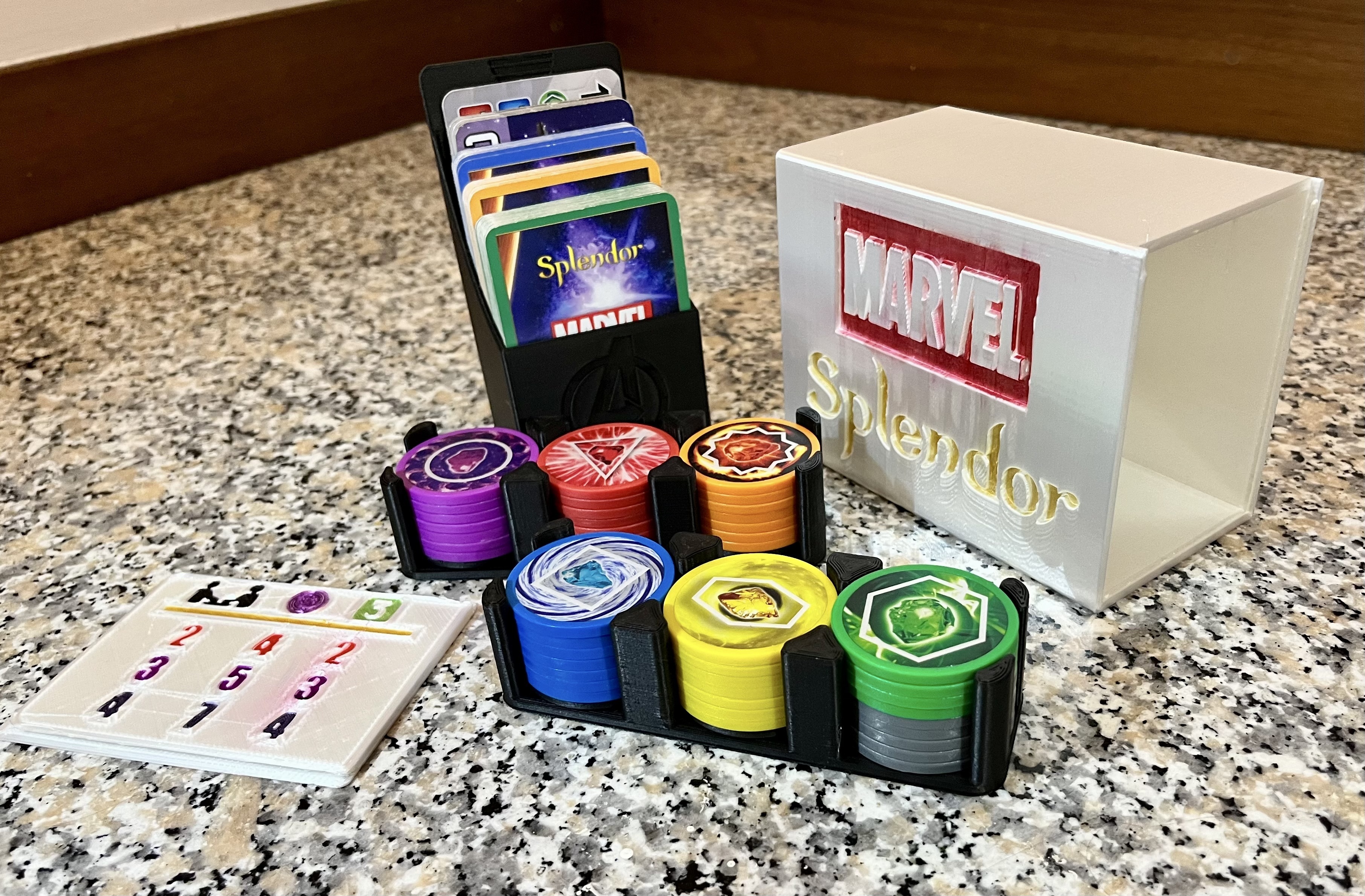
I designed a compact five-part storage system for Marvel Splendor: a main box, lid, categorized card holder, token holder, and five spacers that adapt token depth for different player counts.
What I wanted
I wanted the storage to make the game easier to play.
I needed to fit pieces with very different shapes, keep the cards separated, and make setup and cleanup faster. I also had to account for the rule that games with fewer than four players use fewer tokens.
How I designed it
I gave each of the five parts one clear job.
- Main box: I sized it around the complete packed system.
- Card holder: I divided it around the game’s card categories.
- Token holder: I organized the dense circular pieces so they are easy to reach.
- Five spacers: I changed the usable depth for different player counts.
- Lid: I closed everything into one portable package.
I published it for 100% infill, no supports, and a 0.2 mm layer height. I avoided supports because that makes the parts easier for someone else to print and clean up.
I originally published this image and the model details on my Cults3D page.
How I shared it
I turned my own print into something other people could use.
I published five STL files under my Cupwalk1 account. I named every part, listed how many copies to print, explained the spacers, and included the settings I used.
What I learned
I learned that good CAD starts with how the object will be used.
- I model the inventory before the container. Every card and token category gives me a real size requirement.
- I can turn rules into geometry. The player-count rule gave me the spacer idea.
- I design around the printer. Support-free parts give me fewer failure points and less cleanup.
- I treat documentation as part of the product. Other people need quantities, settings, and a clear explanation.